

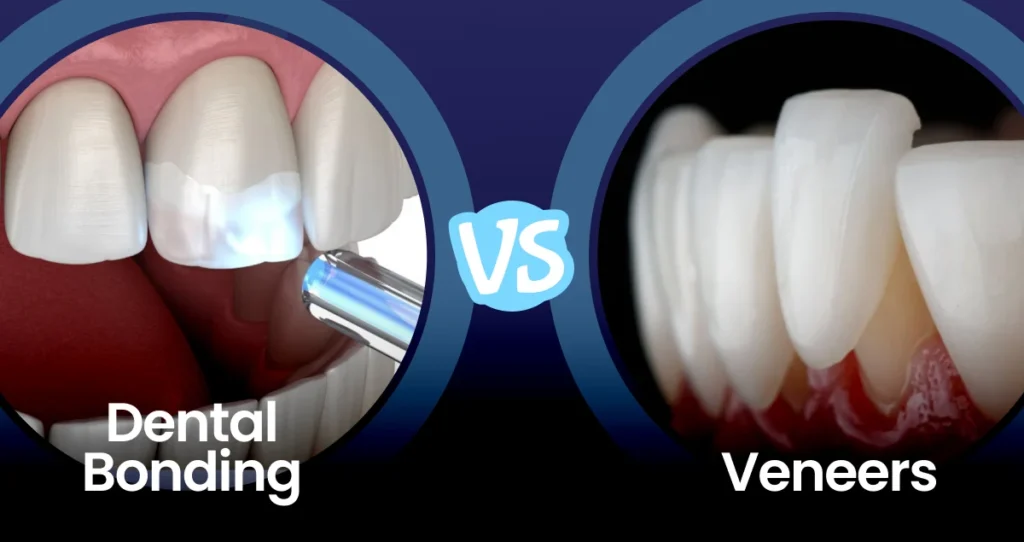
Improving your smile doesn’t always require extensive dental treatment. Dental bonding and veneers are two popular cosmetic dentistry options that can address concerns such as chipped, discoloured, uneven, or misshapen teeth. While both treatments can enhance your smile, they differ in materials, tooth preparation, durability, appearance, treatment time, and cost.
Choosing between dental bonding and veneers depends on your oral health, cosmetic goals, budget, and how much natural tooth structure you want to preserve. Understanding these differences can help you make a more informed decision about your treatment options.
In this guide, we’ll compare dental bonding vs veneers, explain their key differences, explore when each treatment may be appropriate, and discuss the factors to consider when choosing the right cosmetic treatment for your smile.
We’ll also explain how Gillmore Medical Dental can help you explore your options and make an informed decision based on your individual needs.
What Is Dental Bonding?
Dental bonding is a cosmetic treatment that uses tooth-coloured composite resin to improve the shape, size, colour, or appearance of a tooth.
During treatment, the dentist prepares the surface of the tooth so the material can adhere properly. The composite resin is then applied, shaped, and adjusted to create the desired appearance. A curing light hardens the material, after which the dentist polishes it.
Bonding can be used for relatively small cosmetic corrections, including minor chips, cracks, discolouration, uneven edges, and small gaps. It generally requires little or no removal of natural enamel, which makes it a more conservative option than many veneer treatments.
Another advantage is treatment time. Dental bonding can often be completed in a single visit, although the exact appointment time depends on how many teeth are being treated and the complexity of the correction.
What Are Dental Veneers?
Dental veneers are thin shells that cover the front surfaces of teeth. They can be made from porcelain or composite resin and are custom-designed to improve the colour, shape, size, or overall appearance of the teeth.
Porcelain veneers are particularly popular when patients want a highly uniform smile. They are also more resistant to staining than composite bonding. However, porcelain veneers generally require some enamel preparation and are not usually reversible once that enamel has been removed.
Composite veneers use a resin material similar to the material used in dental bonding. They can offer another cosmetic option and may require less treatment time than porcelain veneers.
Before recommending veneers, a dentist should assess the health of the teeth and gums. Active decay or gum disease should generally be addressed before cosmetic treatment.
Dental Bonding vs Veneers: What’s the Difference?
| Factor | Dental Bonding | Dental Veneers |
| Material | Tooth-coloured composite resin | Usually porcelain or composite |
| Treatment time | Often completed in one visit | Composite may take one visit; porcelain usually takes multiple visits |
| Tooth preparation | Usually minimal or no enamel removal | Porcelain veneers generally require removal of some enamel |
| Appearance | Can be shaped and shade-matched to the tooth | Porcelain can provide a highly natural, uniform appearance |
| Durability | Generally requires maintenance or replacement sooner | Porcelain generally lasts longer with proper care |
| Stain resistance | More susceptible to staining than porcelain | Porcelain is highly stain-resistant |
| Repairs | Can often be repaired or touched up | Damaged veneers may need replacement |
| Cost | Generally more affordable | Usually more expensive, particularly porcelain |
When to Consider Dental Bonding
Dental bonding is a conservative and cost-effective option for correcting minor cosmetic imperfections. It may be suitable if you want to improve your smile while preserving as much of your natural tooth structure as possible.
Dental bonding may be worth considering if:
- You have a minor chip, crack, or uneven tooth edge.
- You want to close a small gap between teeth.
- You have a minor cosmetic imperfection.
- You want a more affordable cosmetic treatment.
- You prefer minimal alteration to your natural teeth.
- You want a treatment that can often be completed relatively quickly.
- You need a small correction rather than a complete smile makeover.
When to Consider Dental Veneers
Knowing when to consider dental veneers is particularly important if you are looking at changing several aspects of your smile at once.
Veneers may be worth considering if:
- You want to address multiple cosmetic concerns.
- You have significant discolouration that has not responded well to whitening.
- You want to change the shape or size of several teeth.
- You want a more uniform appearance across multiple teeth.
- You prefer a highly stain-resistant option such as porcelain.
- You want a longer-lasting cosmetic treatment and are comfortable with the necessary tooth preparation.
How to Choose Between Dental Bonding and Veneers
The best choice depends on more than the appearance you want in a photograph. Your dentist should also consider your oral health and the condition of the teeth being treated.
Here are some important factors to discuss:
- Your primary cosmetic concern: A small chip may be easily addressed with bonding, while several concerns affecting multiple teeth may make veneers worth considering.
- Condition of your natural teeth: Decay, gum disease, cracks, or significant structural damage may need to be treated before cosmetic work. In some cases, another restorative treatment may be more appropriate.
- Desired appearance: Both treatments can create natural-looking results. Porcelain veneers are particularly known for their lifelike appearance and stain resistance, while well-shaped composite bonding can also blend closely with natural teeth.
- Budget: Bonding is generally more affordable, although the total cost depends on the number of teeth, amount of work, material, and dental practice.
- Long-term expectations: Consider how long you want the result to last and whether you are comfortable with future repairs, maintenance, or replacement.
- Tooth preparation: If preserving as much natural tooth structure as possible is important to you, ask whether bonding could achieve the result you want.
- Oral health: Cosmetic treatment should not replace necessary dental care. Healthy teeth and gums provide a better foundation for cosmetic procedures.
- Grinding or clenching: Habits such as teeth grinding can affect cosmetic restorations. The Canadian Dental Association specifically notes that grinding or clenching may damage veneers.
- Number of teeth: Treating one chipped tooth is very different from redesigning the appearance of several front teeth. The number of teeth involved can significantly influence the most appropriate approach.
This is why there is no single answer to dental bonding vs veneers that applies to everyone.
How Gillmore Medical Dental Can Help You Choose the Right Cosmetic Treatment
Choosing between dental bonding and veneers starts with understanding your oral health, the condition of your teeth, and your smile goals.
At Gillmore Medical Dental, we offer personalized guidance on cosmetic dentistry options in Maple, Ontario. Our dental assessments help determine whether bonding, veneers, or another treatment may be suitable for improving your smile based on your individual needs.
Rather than focusing solely on achieving a whiter or more uniform smile, we consider factors such as tooth structure, bite alignment, overall oral health, aesthetic preferences, and long-term maintenance to help you make an informed decision.
Final Thoughts
Dental bonding and veneers can both enhance your smile, but the right choice depends on your dental needs and cosmetic goals.
Bonding is often ideal for minor chips, small gaps, and uneven edges because it is generally more affordable and preserves more natural tooth structure. Veneers may be better suited to addressing multiple cosmetic concerns, offering a more uniform appearance and greater stain resistance with porcelain.
Before deciding, consider your oral health, budget, desired results, and long-term maintenance needs. A dental professional can assess your teeth and help you determine which treatment is most appropriate for your smile.
If you’re considering cosmetic dentistry in Maple, Ontario, book a dental appointment with Gillmore Medical Dental today. We’ll help you explore your options and understand the benefits and limitations of each treatment so you can make an informed decision about your smile.
People Also Ask
1. Is dental bonding cheaper than veneers?
Yes, dental bonding is more affordable than veneers, especially porcelain veneers. The final cost depends on the number of teeth treated, the procedure complexity, and the materials used.
2. How long does dental bonding last compared with veneers?
Dental bonding typically lasts several years, while porcelain veneers can last longer with proper care. Both treatments require good oral hygiene and regular dental checkups, and their lifespan depends on your bite, eating habits, and teeth-grinding habits.
3. Dental bonding vs veneers: Which is better for chipped teeth?
For small chips, dental bonding is often a simple option to repair the tooth using tooth-coloured resin. Veneers may be a better fit for more noticeable cosmetic changes, while teeth with significant damage might need a crown or another type of restoration.
4. Which looks more natural: dental bonding or veneers?
Both dental bonding and veneers can look natural when properly matched to your teeth. Porcelain veneers offer excellent stain resistance and lifelike light reflection, while composite bonding can be carefully shaped and colour-matched to blend with surrounding teeth.
5. Can dental bonding fix gaps between teeth?
Dental bonding can fill small gaps between teeth by applying and shaping a tooth-coloured resin. For wider gaps, your dentist may recommend braces, clear aligners, or veneers, depending on what is causing the gap and the condition of your teeth.