

When tooth decay, a crack, or other damage affects a tooth, prompt treatment can help protect its structure and restore normal chewing function.
Two common restorative options are dental crowns and fillings. However, choosing between them is not always straightforward, as several factors matter when comparing a dental crown vs filling. The right treatment depends on the extent of the damage and how much healthy tooth structure remains.
In this guide, we will compare a dental crown vs filling in 2027, exploring their key differences, when each treatment is most suitable, how to choose the right option for your needs, and how Gillmore Medical Dental can help you restore and protect your smile.
What Is Dental Filling?
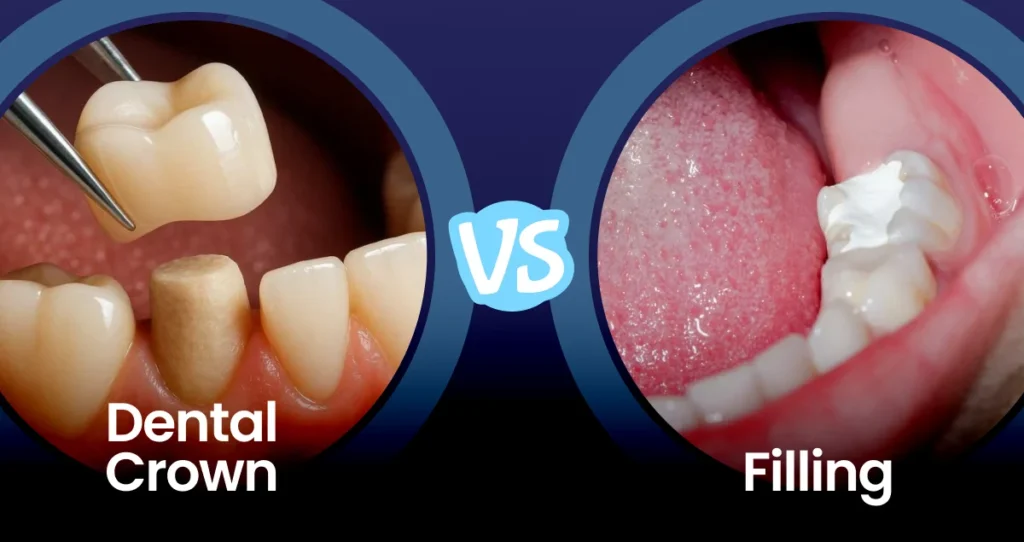
A dental filling restores a tooth after the dentist removes decay or damaged tooth material. The dentist cleans, shapes, and fills the affected area with a suitable restorative material.
This helps restore the tooth’s shape and function while keeping the damaged area covered.
One common option is composite resin, a tooth-colored material that can match the surrounding teeth. Other materials, such as dental amalgam and glass ionomer, may also be considered, depending on the tooth’s location and condition.
According to the Canadian Dental Association’s guide to dental fillings, the dentist removes decay, prepares the affected area, and places the filling material. The choice of material can depend on the tooth, appearance preferences, and cost.
What Is a Dental Crown?
A dental crown is a custom-made restoration that covers the visible portion of a damaged tooth. It acts like a protective cap, restoring the tooth’s shape, appearance, and function. Unlike a filling, which repairs one area, a crown covers the remaining tooth.
Dentists may recommend dental crown treatment when a tooth has extensive decay, a large existing filling, a significant crack, or considerable structural damage. A crown may also be used after root canal treatment when the tooth needs extra protection.
Crowns are available in different materials, including:
- Porcelain or ceramic: Often selected for their natural appearance, particularly for visible teeth.
- Porcelain-fused-to-metal: Combines a metal base with a tooth-coloured outer layer.
- Metal or gold alloy: Offers durability and may be considered for back teeth.
- Composite: A natural-looking option that may be used in selected cases.
The appropriate material depends on the tooth’s location, functional demands, appearance preferences, and the dentist’s recommendation.
Dental Crown vs Filling: Key Differences
Both treatments restore damaged teeth, but they differ in coverage, preparation, and the level of support they provide.
| Factor | Dental Filling | Dental Crown |
| Primary purpose | Repairs a specific area of decay or damage. | Covers and protects a weakened or extensively damaged tooth. |
| Amount of tooth damage | Usually suitable for small or moderate damage. | Often considered for extensive damage. |
| Natural tooth structure | Generally preserves a more healthy structure. | Requires reshaping the tooth to fit the crown. |
| Tooth coverage | Fills the affected area. | Covers most or all of the visible tooth. |
| Treatment process | Decay is removed, and the area is filled. | Tooth is prepared, an impression or scan is taken, and the crown is fitted. |
| Number of appointments | Often one. | Traditional crowns commonly require two or more. |
| Appearance | Composite fillings can match natural tooth colour. | Porcelain and ceramic crowns can provide a natural appearance. |
| Strength and function | Restores the treated area. | Provides broader coverage and support. |
| Durability | Depends on material, size, location, and oral habits | Can last many years with proper care. |
| Maintenance | Regular brushing, flossing, and dental checkups. | Similar daily care, with attention to the crown and surrounding gumline. |
| Cost considerations | Generally less extensive and often less costly. | Usually involves a higher cost because of custom design and additional steps. |
When Is a Dental Filling the More Suitable Option?
A filling is often the preferred option when the damage is minimal, and there’s still enough healthy tooth left to keep it stable.
Your dentist may recommend a filling when:
- The tooth has a cavity or minor damage: A small or moderate area of decay can often be repaired without covering the entire tooth.
- Enough healthy structure remains: The surrounding tooth can support the filling and normal chewing forces.
- The affected area is limited: The damage can be restored without removing additional healthy tooth structure for a crown.
- A tooth-colored material meets your needs: Composite resin may be suitable when appearance matters, and the restoration can withstand the forces on that tooth.
- A more extensive restoration is unnecessary: If the tooth remains structurally sound, a crown may involve more treatment than required.
In many cases, treating decay early lets the dentist use a more conservative restoration and preserve more of the natural tooth.
When Might a Dental Crown Be Considered?
A crown may be appropriate when a filling alone cannot provide enough coverage or support for the remaining tooth.
Your dentist may consider a crown if:
- The tooth has significant structural damage: Extensive decay can leave too little healthy structure to support a filling.
- A large filling has weakened the tooth: When a substantial portion of the tooth has already been restored, a crown may provide additional coverage.
- The tooth is cracked or fractured: Depending on the crack’s location and severity, a crown may help protect the remaining structure.
- The tooth is substantially worn: Grinding, clenching, or other factors can wear down the tooth and affect its strength.
- The tooth needs protection after root canal treatment: Some teeth require a crown to restore and protect the remaining structure.
- A filling may not withstand normal biting forces: A crown may be considered when the remaining tooth needs more extensive support.
A crown isn’t necessarily indicated just because you’ve got a big cavity or an old filling. The dentist must assess how much tooth remains and the degree of damage before deciding whether a crown is required.
Dental Crown vs Filling: Which One Should You Choose?
There is no one-size-fits-all answer. Several clinical and practical considerations determine whether you need a crown or a filling.
- Size and depth of decay: A smaller cavity may be restored with a filling. More extensive decay may leave the tooth too weak for a direct restoration.
- Amount of healthy tooth structure: The remaining natural structure matters. If enough of the tooth remains intact, a filling may be suitable. If much of it is lost, a crown may provide more support.
- Cracks or existing damage: A dentist will consider whether a crack affects only a small area or extends through a larger part of the tooth. The location and severity can change the treatment recommendation.
- Location and bite pressure: Back teeth handle considerable chewing forces. The restoration must withstand the pressure on the affected tooth.
- Appearance and material: Tooth-coloured fillings and ceramic crowns can both provide natural-looking results. The best material depends on the restoration needed and the tooth’s location.
- Expected durability: Both restorations can last for years, but their lifespan varies. The size of the restoration, oral hygiene, grinding habits, diet, and regular dental care all matter.
- Treatment time and cost: Fillings are generally less involved and can often be completed in one visit. Traditional crowns usually require more preparation and additional appointments. Your dentist can explain the treatment estimate and any insurance considerations before proceeding.
Ultimately, a clinical exam is needed to determine the right option. Your dentist may also recommend X-rays or other assessments to determine the extent of the decay or damage.
How Gillmore Medical Dental Can Help With Restorative Treatment
Choosing between a dental filling and crown depends on the extent of tooth damage and your oral health needs. At Gillmore Medical Dental, the dental team examines the affected tooth and recommends suitable restorative options based on its condition.
Whether you have tooth decay, cracks, or worn-down teeth, the team can help you understand your treatment options, expected results, appointment requirements, and costs.
If you are looking for professional restorative dental treatments in Maple, Canada, schedule a consultation with Gillmore Medical Dental today. Get personalized guidance to restore your tooth’s function, protect its structure, and maintain your smile.
Wrap Up
Choosing between a dental crown and a filling depends on the extent of tooth damage, the remaining healthy structure, and your oral health needs. Fillings suit minor damage, while crowns provide more coverage and support for weakened teeth.
A dental exam can help determine the best treatment.
If you’re unsure which option is right for you, Gillmore Medical Dental is here to help. Schedule a restorative dental treatment consultation in Maple, Canada, to discuss your options and get personalized recommendations to restore and protect your smile.
People Also Ask
Is a crown better than a filling for a damaged tooth?
Not always. A filling is suitable for minor decay or damage when enough healthy tooth structure remains. A crown is generally recommended when a tooth is significantly weakened and needs more coverage and support.
When does a cavity need a crown instead of a filling?
A cavity may need a crown when decay affects a large portion of the tooth, leaving insufficient healthy structure to support a filling.
The dentist determines the appropriate treatment based on the extent of decay and remaining tooth structure.
Which lasts longer, a dental crown or a filling?
Dental crowns typically last 10 years or longer with proper care, according to the Canadian Dental Association. Fillings can also last for years, depending on their material, size, location, and biting pressure. Regular dental checkups help extend the lifespan of both restorations.
Can a large filling be replaced with a dental crown?
Yes. A dentist may recommend replacing a large or damaged filling with a crown if the tooth has become weakened. A crown provides greater coverage and support, although not every large filling requires replacement.
How does a dentist decide between a crown and a filling?
A dentist examines the tooth, evaluates the extent of damage, and checks how much healthy structure remains. They may also consider cracks, tooth location, bite pressure, and oral health.
They may recommend dental X-rays to help determine the most suitable restoration.