

Missing a tooth? You’re not alone.
Understanding Dental Bridges vs Implants, including their benefits, drawbacks, and long-term effects, can help you make the best decision for your smile.
Replacing missing teeth affects more than appearance. It impacts how you speak, chew, and maintain overall oral health. This blog covers everything you need to choose between dental bridges and implants confidently.
You’ll discover how each option works, their differences, and which teeth replacement solution best aligns with your oral health goals, lifestyle, and budget.
Why Replacing Missing Teeth Matters
Over time, failing to treat a missing tooth can lead to more serious dental problems. Tooth replacement helps maintain health and function.
Among the major causes to act are:
- Prevents tooth shifting: Neighboring teeth can drift into empty spaces, therefore producing misalignment.
- Keeps bite and jaw healthy: Gaps could change your bite and overstrain your jaw joints.
- Slowing bone loss: Missing teeth speeds jawbone damage.
- Increases self-assurance: Full smiles enhance social comfort and self-esteem.
- Proper spacing: It improves the effectiveness of flossing and brushing.
Early intervention usually results in better outcomes and reduced long-term expenses.
Understanding Dental Bridges
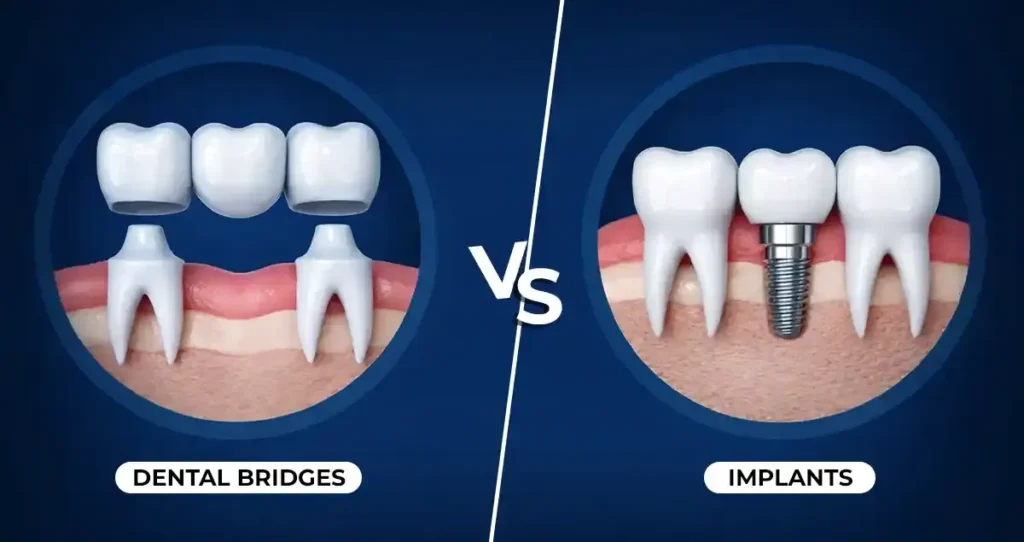
It is a fixed restoration that uses neighboring teeth or implants to support and replace one or more missing teeth.
Varieties of Dental Bridges
- Conventional Bridges: Supported by crowns on neighboring teeth.
- Cantilever Bridges: Fastened only on one side.
- Maryland Bridges: Bonding with ceramic or metal wings.
- Implant-Supported Bridges: Secured by dental implants rather than by teeth.
Advantages of Dental Bridges
- Quicker treatment schedule.
- Surgical procedure not needed.
- More inexpensive initially.
- Time-tested, trustworthy remedy for decades.
Factors to Consider
- Healthy next teeth have to be reconfigured.
- Often lasts 5–15 years.
- Do not stop jawbone deterioration below the lost tooth.
- Over time, it may need to be replaced.
Bridges are often ideal when neighboring teeth already require crowns or when surgical procedures are not recommended.
Understanding Dental Implants
Dental implants replace the tooth root. A titanium post is inserted into the jawbone and topped with a custom-made crown to restore the missing tooth.
Advantages Of Dental Implants
- Preserves facial structure and jawbone.
- Does not influence surrounding teeth.
- Exceptionally strong (usually 20+ years).
- Seems and feels just like a real tooth.
- Supports long-term oral health.
Potential Drawbacks
- Higher initial cost.
- Calls for little oral surgery.
- Longer time of therapy (3–6 months).
- Adequate bone density is necessary.
Dental Bridges vs Implants: Key Differences
When comparing options, it’s important to focus on practical, long-term factors rather than just the initial cost.
Longevity
- Bridges: Average 5 to 15 years.
- Implants: Twenty years or more with appropriate maintenance.
Bone Preservation
- Bridges: Do not prevent bone loss in the area
- Implants: Help maintain bone density and strength
Procedure Complexity
- Bridges: Non-surgical and faster.
- Implants: Surgical implantation needed.
Cost Considerations
- Bridges: Lower initial cost.
- Implants: More initial cost, better long-term value.
Upkeep
- Bridges: Require daily brushing, flossing, and routine dental check-ups.
- Implants: Require the same daily care, plus periodic professional evaluations to ensure long-term success.
Dental Bridges vs Implants: Factors To Consider Before Making A Decision
There is no one-size-fits-all solution. A dentist will evaluate several individual factors, including:
- Total oral and gum health.
- Jawbone density and volume.
- Coverage under insurance and budget.
- Aesthetics and desired lifespan.
- Lifestyle practices, including smoking, food, and oral hygiene.
Choosing between dental bridges and implants depends on a thorough consultation to guarantee expected, long-lasting outcomes.
How Gillmore Medical Dental Can Help
Gillmore Medical Dental offers dental bridges and implant services tailored to your needs. Our experienced team delivers reliable outcomes by using modern diagnostic tools and creating customized treatment plans.
What You Can Expect
- Competency in both restoration choices.
- Cost openness and clearly specified therapy schedules.
- Cutting-edge technology for exact placement.
- Compassionate, patient-centered care.
Professional dental bridges and implant services help patients receive guidance at every stage, from assessment to ongoing maintenance.
Wrap Up
Replacing missing teeth is a wise investment in your comfort, confidence, and overall health. Knowing the differences between dental bridges and implants will help you make a smart choice that aligns with your goals.
While bridges provide a quicker and more affordable initial solution, implants offer unmatched bone preservation and long-term benefits. Your oral health, lifestyle, and long-term objectives should guide your decision.
If you’re ready to explore your options and take the next step toward a complete, healthy smile, schedule a consultation with Gillmore Medical Dental today.
FAQs
How long does it take to get a dental implant?
Dental implants typically take 3 to 6 months to fully integrate with the jawbone before the crown can be placed.
Can an implant replace a bridge later on?
Yes. Some patients start with a bridge and later switch to an implant if their oral health and bone density allow.
Is getting a dental implant painful?
Most patients experience only mild discomfort. Local anesthesia and modern techniques make the procedure manageable and virtually pain-free.
How do I care for bridges versus implants?
Both bridges and implants require daily brushing, flossing, and regular dental check-ups. Implants also need periodic professional assessments to ensure long-term success.
Does insurance cover dental bridges or implants?
Coverage varies by plan. Bridges are often covered at a higher rate, while implants may receive partial coverage depending on your specific insurance policy.