

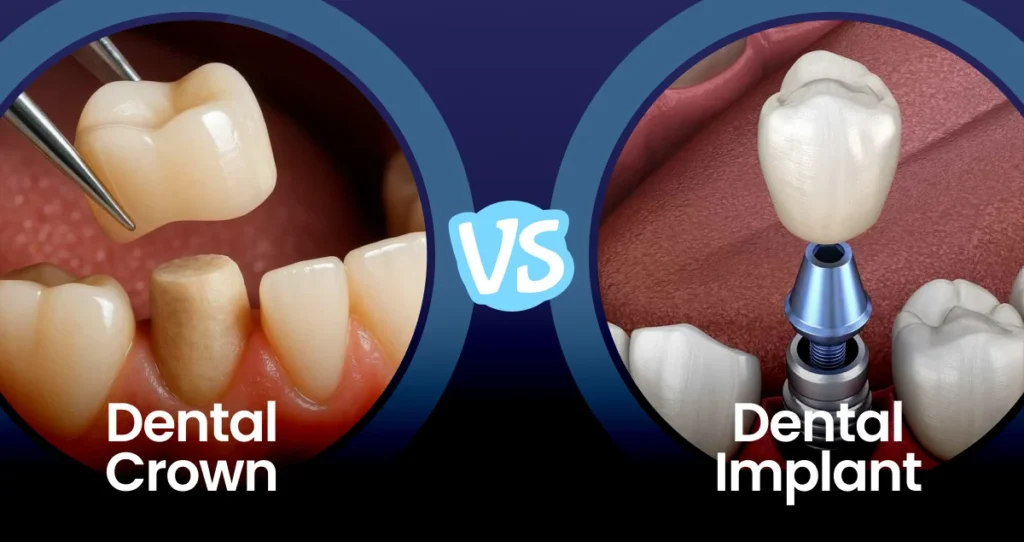
Choosing between a dental crown and a dental implant can be confusing, especially since both treatments can restore your smile’s appearance and function.
However, they serve different purposes. A crown generally restores a natural tooth that is still present but damaged or weakened, while an implant replaces a missing tooth root and supports a replacement tooth.
When comparing a dental crown vs dental implant, several factors matter. The right choice depends on what is happening inside your mouth, not simply on which treatment sounds more durable or modern.
In this guide, we will compare a dental crown vs dental implant in 2027, covering their key differences, when each treatment is most suitable, how to choose the right option for your needs, and how Gillmore Medical Dental can help.
What Is a Dental Crown?
A dental crown is a custom-made cap that fits over a damaged or weakened tooth. It is sometimes called a cap because it covers the visible portion of the tooth above the gumline.
A crown may be recommended when decay, a large filling, a crack, an injury, or certain dental treatments such as root canal therapy have significantly weakened a tooth.
The goal is to protect the remaining tooth structure while restoring its shape, strength, function, and appearance.
Crowns are available in different materials, including metal, porcelain, composite, and porcelain-fused-to-metal options. The best material depends on factors such as the tooth’s location, functional demands, appearance, and your dentist’s recommendation.
What Is a Dental Implant?
A dental implant replaces the root of a missing tooth. Unlike a crown placed over an existing tooth, an implant is surgically placed into the jawbone and acts as an anchor for a replacement tooth.
A complete implant-supported tooth generally involves three main components:
- Implant: The post placed into the jawbone to replace the tooth root.
- Abutment: The connector attached to the implant.
- Crown: The visible replacement tooth attached to the abutment.
The Canadian Dental Association explains that dental implants may be considered when one or more teeth are missing.
Successful implant treatment generally requires healthy gums and sufficient supporting bone. In some cases, bone grafting may be considered when not enough bone is available.
Implant treatment also involves a longer healing process than a conventional crown because the implant needs time to integrate with the surrounding bone.
Dental Crown vs Dental Implant: Key Differences
| Factor | Dental Crown | Dental Implant |
| Purpose | Restores a damaged existing tooth | Replaces a missing tooth and root |
| Suitable dental condition | Natural tooth is present and restorable | Tooth is missing or cannot be predictably restored |
| Treatment process | Tooth is prepared, and crown is fitted over it | Implant is placed in bone, followed by an abutment and replacement crown |
| Tooth preservation | Preserves the remaining natural tooth | Replaces the missing tooth root |
| Oral surgery | Usually does not require implant surgery | Requires surgical placement of the implant |
| Treatment timeline | Often completed over one or more appointments | Usually takes longer because of healing and integration |
| Appearance | Can be designed to match surrounding teeth | Replacement crown can be designed to look natural |
| Function | Restores an existing tooth’s function | Provides a fixed replacement for a missing tooth |
| Durability | Crowns can last 10 years or longer with good care | Implants can provide long-term tooth replacement, but require ongoing care |
| Maintenance | Brush, floss, and attend regular dental visits | Brush, floss, and attend regular dental visits |
| Cost considerations | Generally involves restoring one existing tooth, so total cost may be cheaper than an implant | Usually involves multiple components and surgical treatment, so that total cost may be higher |
When Is a Dental Crown the More Suitable Option?
A crown may be the more suitable treatment when the natural tooth is still present and has enough healthy structure to support the restoration.
Common situations include:
- The tooth is weakened, cracked, or significantly damaged.
- A large filling has reduced the tooth’s remaining strength.
- The tooth has undergone root canal treatment and needs additional protection.
- Decay or injury has changed the tooth’s shape and function.
- You want to restore an existing tooth rather than replace it.
- The remaining tooth structure is strong enough to support a crown.
A severely damaged tooth does not automatically need to be extracted. In some cases, a crown can protect and restore a tooth that might otherwise be lost.
However, the tooth must be assessed carefully to determine whether enough healthy structure remains.
When Might a Dental Implant Be Considered?
A dental implant may be considered when a tooth is missing or when a natural tooth cannot be predictably restored.
It may be appropriate when:
- A tooth is already missing.
- A severely damaged tooth cannot be successfully restored.
- You want a fixed replacement rather than a removable option.
- You want to replace the missing root as well as the visible tooth.
- Your gums and jawbone can support implant treatment.
- You want a long-term tooth-replacement option.
An implant can also avoid relying on neighboring natural teeth for support. However, dental implant treatment is not suitable for everyone. Your dentist needs to assess your gums, available bone, remaining teeth, bite, and overall oral health before recommending it.
Dental Crown vs Dental Implant: Which One Should You Choose?
Choosing between a dental crown and a dental implant requires more than comparing their benefits. Before making a decision, consider these factors:
- Dental examination: Understand your current tooth condition and available treatment options.
- Oral health: Discuss any existing gum disease, decay, or other dental concerns.
- Treatment expectations: Consider the expected results, treatment duration, and long-term maintenance.
- Cost: Compare the estimated treatment costs and available insurance coverage.
- Professional advice: Ask your dentist about the benefits, limitations, and potential risks of each option.
Your dentist can evaluate your individual needs and help you choose a treatment that supports your oral health and long-term dental goals.
How Gillmore Medical Dental Can Help With Restorative Treatment
Choosing between a dental crown and an implant starts with a proper dental assessment. At Gillmore Medical Dental, we provide personalized guidance based on your tooth condition, gum health, and overall oral health.
We offer restorative dental treatments in Maple, Ontario, including dental crowns and implants, to repair damaged teeth and replace missing ones. Our team evaluates your needs to recommend suitable treatment options.
Whether you need a dental crown or dental implant, a professional consultation helps you explore your options and find the right treatment for your smile.
Wrap Up
Choosing between a dental crown and a dental implant depends on your tooth condition, overall oral health, and long-term dental needs.
While a crown can restore and protect a damaged natural tooth, an implant replaces a missing tooth. Both treatments can improve your smile and chewing function when recommended for the right situation.
The best way to determine which option suits you is through a professional dental evaluation.
At Gillmore Medical Dental, our team can assess your dental needs, explain your treatment options, and help you decide.
If you have a damaged or missing tooth, don’t delay getting it checked. Book a dental appointment at Gillmore Medical Dental in Maple, Ontario, to explore your restorative treatment options and take a positive step toward a healthier, more confident smile.
People Also Ask
Are dental implants more durable than dental crowns?
Dental implants are designed as long-term tooth replacements, while dental crowns typically last 10 years or longer with proper care. However, both require regular maintenance, and their lifespan depends on oral hygiene, bite forces, and other factors.
How long does a dental crown last compared with a dental implant?
A dental crown can last 10 years or longer. Dental implants can last much longer, but their replacement crowns may need repair or replacement over time. Regular dental checkups help maintain both.
Which costs more: a dental crown or a dental implant?
A dental implant generally costs more because treatment involves surgical placement, an abutment, and a replacement crown. A conventional crown usually costs less, but the final price depends on materials and treatment complexity.
Can you get a crown if your tooth is severely damaged?
Yes, a severely damaged tooth may still be restored with a crown if enough healthy tooth structure remains. If the tooth cannot be saved, extraction and replacement with a dental implant may be considered.
How do I know whether I need a dental crown or implant?
You may need a crown if your natural tooth is damaged but can be restored. An implant may be suitable if you’re missing a tooth or can’t save it. Your dentist will assess your tooth, gums, jawbone, and overall oral health before recommending treatment.