

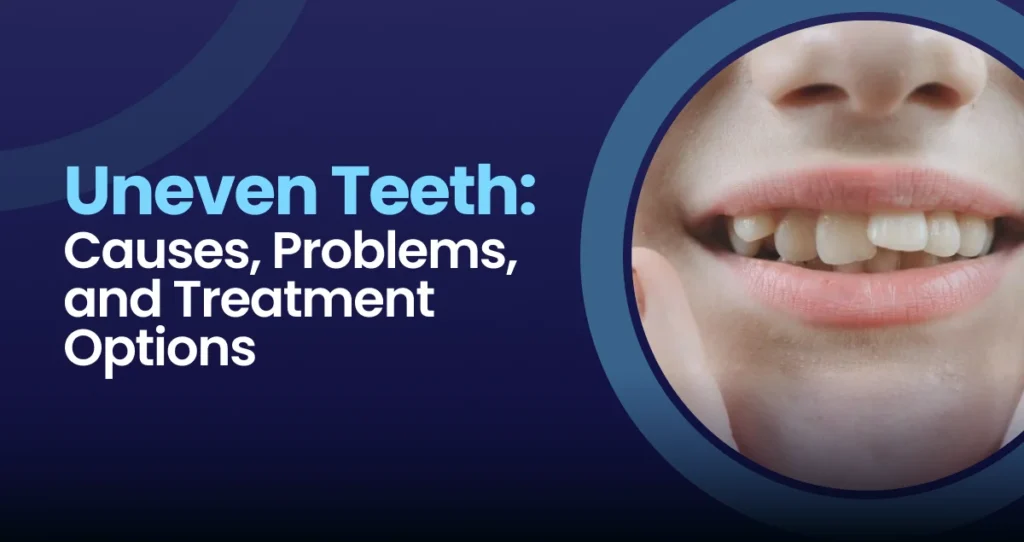
Ever feel self-conscious about a crooked tooth, overlapping teeth, or noticeable gaps when you smile? You’re not alone.
While perfectly straight teeth aren’t necessary for a healthy smile, uneven teeth can sometimes affect more than just your appearance.
Discomfort while eating or biting, problems with brushing and flossing, and the alignment of the top and bottom teeth may all be caused by uneven teeth. Although some people might consider it a minor aesthetic issue, for others, it might lead to ongoing dental problems.
But why do teeth become uneven in the first place?
In this guide, we’ll explore the common causes of uneven teeth, the problems they may cause, and the dental treatment options available to help you achieve a healthier, more confident smile.
What Are Uneven Teeth?
Uneven teeth is a general term for teeth that don’t line up neatly along the dental arch. People often use several related terms for this. Although they’re related, each term refers to a slightly different type of tooth alignment problem.
- Crooked teeth lean, twist, or sit at an odd angle.
- Crowded teeth happen when there isn’t enough room in the jaw, so the teeth overlap or rotate to fit.
- Overlapping teeth are when one tooth sits partly in front of or behind its neighbour.
- Unevenly spaced teeth have noticeable gaps between them, making the spacing look irregular.
Most of the time, these differences mainly affect how your smile looks. If they’re more pronounced, they can also change the way your upper and lower teeth come together when you close your mouth.
Common Causes of Uneven Teeth
It’s rarely just one thing. Several factors influence how teeth align in many individuals, with some being innate and others arising as time goes on.
Genetics and Jaw Development
Your genes significantly influence the size of your teeth, the configuration of your jaw, and the development of your dental arches. If your teeth are on the larger side and your jaw is on the smaller side, they won’t all fit in a neat row.
Differences in how the jaw grows can also lead to gaps or a bite that doesn’t line up.
Crowded Teeth and Limited Space
When too many teeth are fighting for too little space, something has to give. Teeth may come in at an angle, turn, or overlap.
Crowding typically becomes apparent as permanent teeth replace primary teeth, particularly if the jaw has not developed enough to accommodate them.
Early Loss of Baby Teeth
Children may chew with their baby teeth, but they have other uses as well. They also make space for the permanent teeth growing underneath.
Adjacent teeth may move into the vacant area if a baby tooth falls out too soon because of decay or damage. There may not be enough room for the adult tooth to erupt when it is ready.
Thumb Sucking and Other Childhood Habits
Thumb sucking, long-term pacifier use, and tongue thrusting can affect how some children’s teeth and jaws develop.
A short phase usually isn’t a concern. What matters most is how long the habit lasts, how often it happens, and how much pressure is involved.
Missing Teeth and Tooth Shifting
This also applies to adults. Over time, neighbouring teeth tend to lean or drift into the gap if an adult tooth is lost and the space isn’t filled.
This may alter your bite and mess up the alignment and spacing of the other teeth.
Wisdom Teeth and Other Dental Changes
Wisdom teeth often get blamed for crooked front teeth, but the link isn’t that simple. They can cause discomfort or problems at the back of the mouth, especially when they’re impacted or don’t have room to come in. But front teeth can shift for other reasons too, including natural changes with age and gum health.
The Canadian Dental Association (CDA) explains that several factors can influence how teeth develop and align, including genetics, childhood habits, and tooth loss. These factors can affect the position of individual teeth and the overall alignment of the bite.
What Problems Can Uneven Teeth Cause?
Not every uneven tooth is a health problem. Some are purely cosmetic. Others can make everyday things like eating and brushing a little harder.
Difficulty Cleaning Teeth Properly
When teeth overlap or sit too close together, cleaning between them becomes tricky. Food particles and plaque can get trapped in these spaces, even with regular brushing.
Increased Risk of Gum Problems and Tooth Decay
Crowded teeth increase your risk of cavities and gum inflammation due to the plaque that gathers between them. Gum problems can eventually impact the tissue and bone that hold your teeth in place if they are not treated.
If parts of your mouth are hard to clean, careful brushing and regular checkups become even more important.
Bite Problems and Uneven Tooth Wear
When teeth do not meet evenly, some are subjected to more pressure than others. Additionally, this increased pressure can make chewing difficult and cause enamel to erode more quickly in some areas.
In some situations, it may also increase the likelihood that a tooth will chip.
Jaw Discomfort in Some Cases
Sometimes, tight or painful jaw muscles might accompany an imbalanced bite. Because there are so many potential causes of jaw discomfort, if it persists, have it checked out rather than assuming your teeth are the cause.
Changes in Smile Appearance and Confidence
Sometimes, the biggest concern is how uneven teeth look. Gaps, overlapping teeth, or crooked edges can make you feel less confident when smiling, talking, or posing for photos.
Best Treatments for Uneven Teeth in 2027
The best fix depends on what’s actually going on. The issue might be where the teeth sit, what shape they are, how they bite together, or some combination of the three. These are the options your dentist may talk through with you.
Clear Aligners
Clear aligners are a series of custom-made, see-through trays. Each set applies gentle pressure to move your teeth a little at a time, and you switch to a new set every time until your teeth reach their planned positions.
For alignment problems that are modest to moderate, they frequently function effectively. However, they are not appropriate in all situations. More complex tooth movements or bite problems may call for a different orthodontic approach.
Braces
Traditional braces use brackets and a wire to guide teeth into place over time. They can handle a wide range of issues, including crowding, gaps, and certain bite problems.
The type of braces you’d need and how long treatment would take depend on your teeth and what you’re hoping to achieve.
Dental Bonding
During a dental bonding, the dentist applies a tooth-coloured composite resin to the tooth and shapes it by hand.
It’s a quick solution for evening out crooked borders, closing tiny spaces, mending chips, or aligning a smaller tooth with its neighbours.
Porcelain Veneers
Veneers are thin, custom-made porcelain shells bonded to the front of selected teeth. They can change the visible shape, size, and colour of those teeth, which can make a smile look more even overall.
Other Restorative or Cosmetic Treatments
If a tooth is badly damaged, weakened, or misshapen, your dentist might suggest a crown or another restorative or cosmetic treatment. These treat the condition of that specific tooth. They don’t straighten your other teeth.
Which Treatment Is Right for You?
The results you desire, your bite, and the degree to which your teeth are crooked will all determine the best treatment. Before making a recommendation, your dentist will examine your teeth and look for problems like gum disease or cavities.
A slightly misaligned tooth could need a different approach than one that is heavily crowded or overlapping. Additionally, your personal preferences, treatment length, and budget are important.
Keep in mind that bonding and veneers improve teeth’s look, whereas braces and clear aligners move them physically. In some cases, a combination of treatments may be recommended.
Before choosing, talk to your dentist about expected results, possible limitations, and long-term maintenance.
Can Uneven Teeth Be Prevented?
Not always. Genetics and jaw growth play too big a role for anyone to prevent every case. Still, a few habits can lower some of the risks:
- Maintain routine dental visits, particularly for children, allowing the dentist to monitor the growth of their teeth and jaw.
- If your child is still thumb-sucking or has some other similar habit past the early years, ask a dental professional how to deal with it.
- Brush twice a day and clean between your teeth to prevent decay and gum problems.
- If you lose a tooth, then speak to your dentist about replacing it before the adjacent teeth start to drift.
- Book an assessment if you notice new gaps, teeth that seem to be moving, or a bite that suddenly feels different.
Catching problems early won’t prevent every alignment issue, but it gives you more options and a better chance of fixing things simply.
How Gillmore Medical Dental Can Help
If you’re unhappy with your smile or concerned about how your teeth fit together, the team at Gillmore Medical Dental in Maple, ON, can help identify the cause and explore suitable treatment options.
During your assessment, we’ll examine your tooth alignment, bite, and overall oral health to determine whether the concern is mainly cosmetic, orthodontic, or related to another dental issue.
Depending on your needs, treatment may include Invisalign clear aligners, porcelain veneers, or dental bonding. Each option addresses different concerns, so we’ll recommend an approach based on your dental health and smile goals.
We will guide you through the available options, clarify what to anticipate, and assist you in selecting a treatment that aligns with your preferences.
Wrap Up
Uneven teeth can affect more than just the appearance of your smile. Depending on the cause and severity, they may also make brushing and flossing difficult, affect your bite, or contribute to uneven tooth wear.
Fortunately, treatments such as Invisalign, braces, dental bonding, and porcelain veneers can help address different alignment and cosmetic concerns.
If you’re concerned about uneven teeth, Gillmore Medical Dental can help you explore the right treatment options. Our dental team will assess your teeth and bite, discuss your concerns, and recommend a treatment approach based on your needs.
Book your appointment at Gillmore Medical Dental in Maple, ON, and take the first step towards a healthier smile!
FAQs
Are veneers a good option for uneven teeth?
Especially when the teeth’s shape, size, or colour is the main problem, veneers may improve the appearance of slightly crooked teeth. However, they don’t fix major alignment issues and may require some enamel removal.
How do uneven teeth affect your bite?
Teeth that are not aligned properly can create inconsistent force during chewing. Over time, this can cause wear on the teeth, difficulty chewing, or discomfort in the jaw.
Do uneven teeth always need treatment?
No. Slightly uneven teeth may not need treatment unless they affect your bite, cleaning, or oral health.
Can uneven teeth get worse over time?
Yes. Age, tooth loss, and gum problems can cause teeth to shift. If you notice changes, have your dentist check them.